

For the last decade, the strategic mandate for every major corporation has been the same: “Act like a startup.”
They built innovation labs, venture arms, hired Chief Digital Officers, and obsessed over agility. The goal was to build technical moats to protect them from disruption.
That era is over.
We are entering an era where innovation, specifically technical and creative capability, is being democratized to the point of commoditization. Before we discuss the solution, we need to understand the fundamental shift in the competitive landscape.
Here are the four forces dismantling the old rules of business:
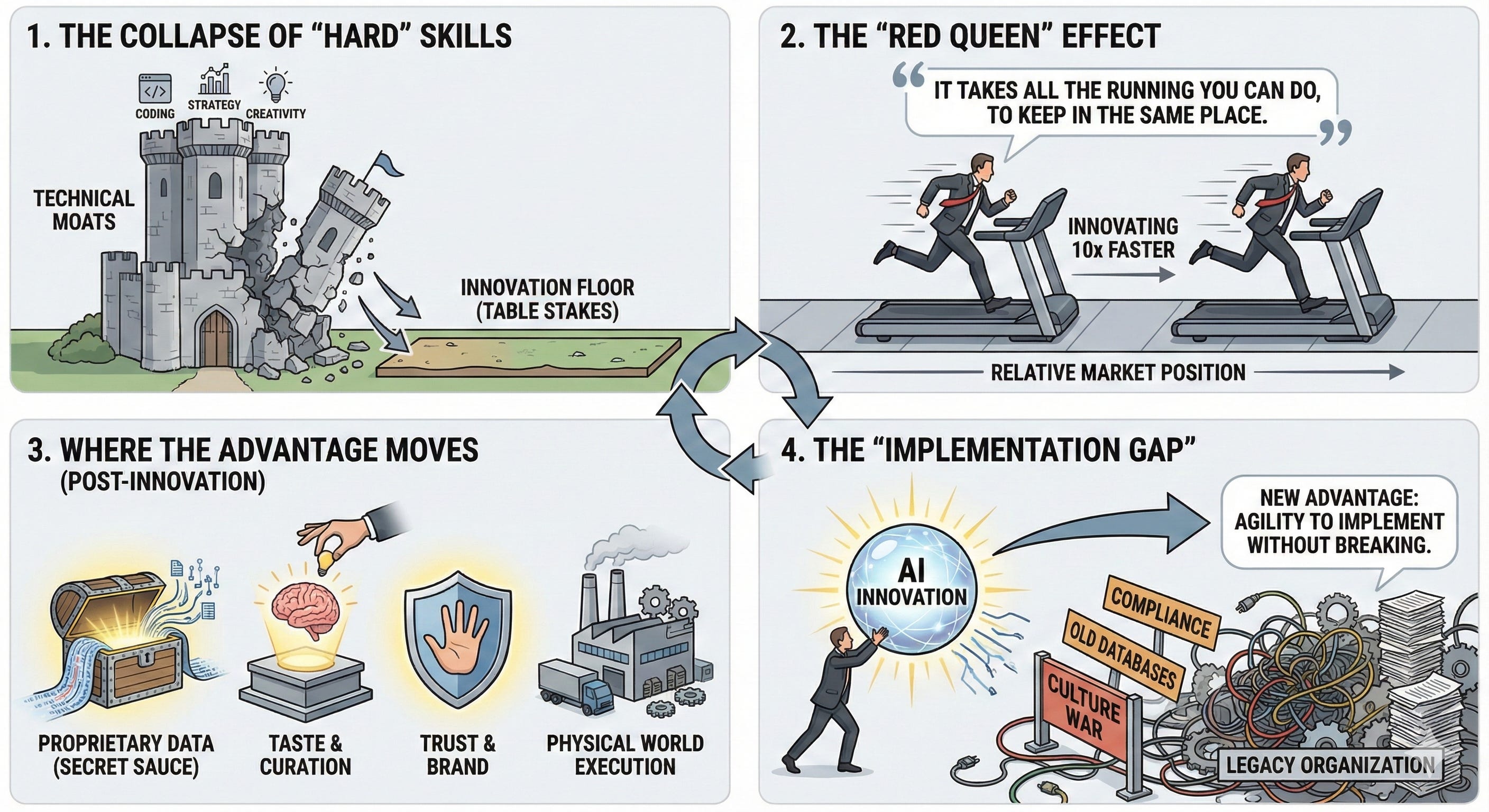
1. The Collapse of “Hard” Skills
For the last 30 years, competitive advantage often came from “technical moats.” If you could write better code, design better algorithms, or produce higher-quality creative assets than your neighbor, you won.
AI flattens this.
Coding: An innovative app idea that used to require a team of six engineers and $500k can now be prototyped by one person with an LLM in a weekend.
Strategy: Strategic analysis that used to require McKinsey is now a 30-second prompt away.
Creativity: High-fidelity images and copy are now commodities.
The Result: The “floor” of innovation has been raised so high that “being innovative” is now just table stakes. It is the baseline requirement to exist, not a strategy to win.
2. The “Red Queen” Effect
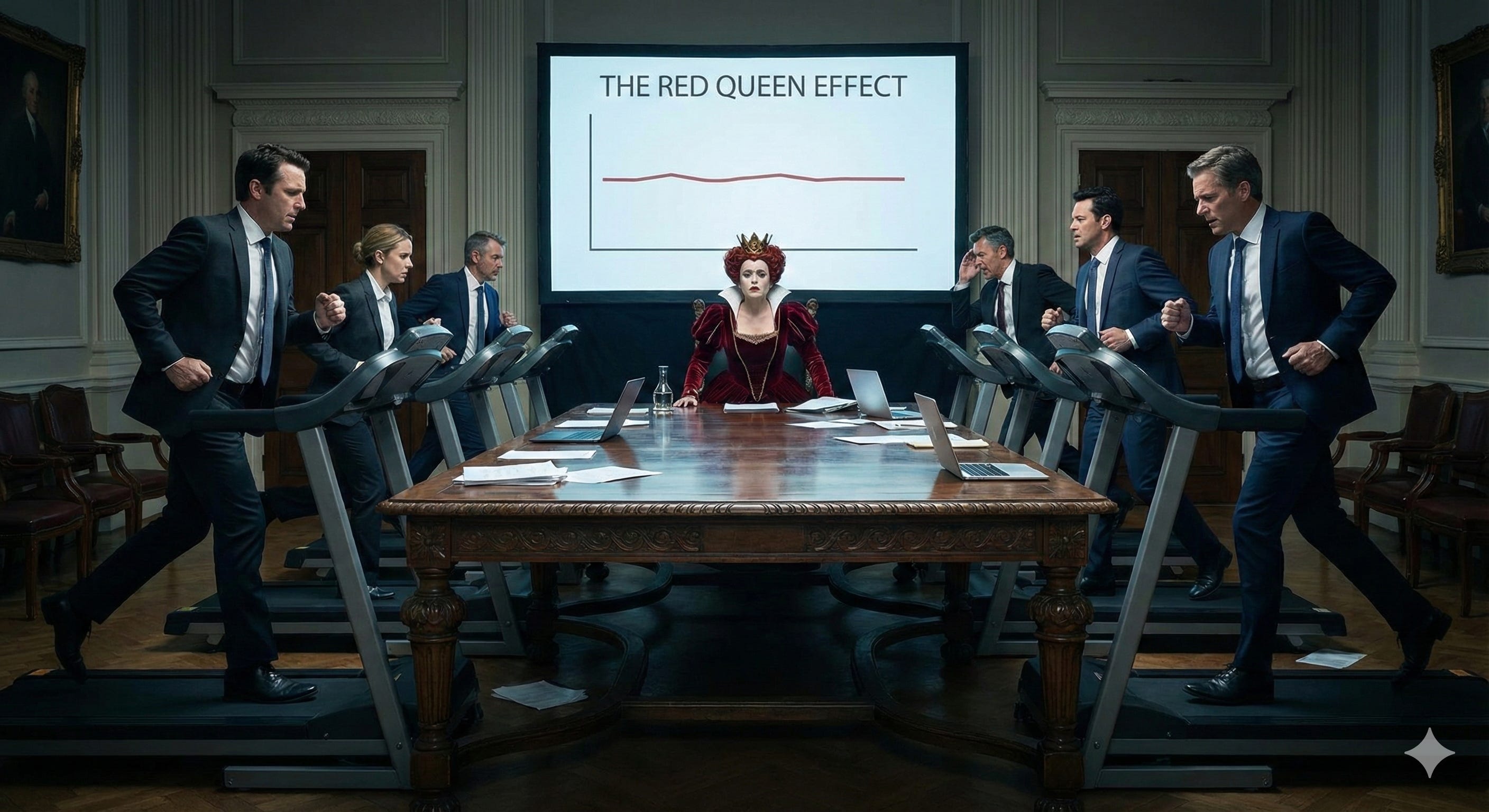
There is a concept from evolutionary biology (and Alice in Wonderland) called the Red Queen Hypothesis: “It takes all the running you can do, to keep in the same place.”
If AI allows you to innovate 10x faster, but it also allows your competitor to innovate 10x faster, net competitive advantage is zero. You are both just running faster to stay in the same relative market position. Innovation becomes an operational cost, not a profit driver.
3. Where the Advantage Moves (Post-Innovation)
If inventing the solution is easy, the competitive advantage moves to things AI cannot easily replicate yet. We are seeing a shift from “Who can build it?” to “Who can verify and sell it?”
Here is where the new moats are being dug:
Proprietary Data (The “Secret Sauce”): Everyone has the same engine (GPT-5, Claude, Gemini 3), so the car that wins is the one with the best fuel. Companies with unique, messy, non-public historical data will win because their AI will know things yours doesn’t.
Taste and Curation: When AI generates 1,000 ideas in a minute, the value shifts to the human who has the taste to pick the one idea that culturally resonates. The scarcity is no longer generation; it is selection.
Trust and Brand: As AI floods the world with average-to-good content and products, consumers will retreat to brands they trust. “Human-verified” or “Authentic” becomes a luxury good.
Physical World Execution: AI can invent a better logistics route or a new product design instantly, but it cannot physically drive the truck or manufacture the widget (yet). Hard, physical infrastructure becomes a major moat again.
4. The “Implementation Gap”
There is one final friction point. Just because innovation is democratized doesn’t mean organizations can absorb it.
The Innovation: “Here is a perfect AI agent to handle customer service.”
The Reality: The company has 20-year-old legacy databases, strict compliance laws, and a culture that hates change.
The new competitive advantage isn’t having the innovative idea; it is the organizational agility to actually implement it without breaking everything.
A First Step
A first step could be to perform a “Friction Audit” across the legacy business: define the three most expensive, slowest, or most error-prone processes that are currently impossible to automate due to messy data or compliance fears. Instead of building a new “AI tool” in a silo, the team’s mandate becomes deep integration into one of these friction points. Their KPI shifts from “number of ventures launched” to “measurable reduction in operational friction.” This means the innovation team needs to embed themselves within the business unit, learning the legacy systems and cultural roadblocks, and using their technical expertise to weave AI into the existing fabric of the company, rather than trying to drape a new fabric over it.