

We are taught that time is money. But it may be more accurate to say that money is time. Hours of our lives, stored and translated into a universal token. A paycheck is proof that our attention, our skill, our effort in a given week have been transformed into something we can carry forward, to exchange for whatever sustains us.
Most of us first learn this lesson through work. You show up at an organization, a hospital, a design firm, a tech startup. You offer your time, and the org pays you for it. Far from being a bad bargain, this exchange can be liberating. On your own, it might take weeks to grow vegetables or build a roof. With wages in hand, you can walk into a supermarket or sign a lease, trading hours of labor for food already harvested, for shelter already built. You get to spend your best energy on your craft, while relying on the strengths of others for the rest.
This is the quiet genius of the market: specialization and exchange. Adam Smith described it centuries ago. A factory magnifies the weaver’s hour; a distribution network magnifies the factory. Companies are leverage machines, able to turn your one hour into many. And in the process, they create communities: the colleagues who become friends, the stability of a paycheck, the sense of belonging to something larger than yourself.
But here is where the story begins to shift. For centuries, the most powerful forms of leverage: capital, machinery, intellectual property, global reach, belonged almost exclusively to large companies. If you wanted your hours to amplify more than a single pair of hands could manage, you had to hand them over or take on the many years of entrepreneurship yourself, and the high risk that is necessary to build your own leverage from scratch. (Read Atlas Shrugged or the Hard Thing About Hard Things to feel what that is like.)
Now, the tools of leverage are slipping outwards, powered by three powerful forces. Firstly, AI is enabling all the worlds intelligence to be available on demand, and in any device, lifting every other technology’s useful value too. Secondly, the fall of solar energy costs and its increasing availability ( Amazing article on that here.) And the third, social media, meaning anyone can sell directly to millions, without the need for a middleman.
A New Kind of Workshop
Look ahead a decade. By 2035, the world hums not just with factories and server farms but with small-scale machines in garages, basements, and backyards. Already, John Deere has unveiled fully autonomous tractors, and researchers at MIT have 3D printed entire houses in less than a day. The International Energy Agency has declared solar “the cheapest electricity in history,” with costs down more than 60 percent over the past decade. Home batteries can now power neighborhoods through the night.
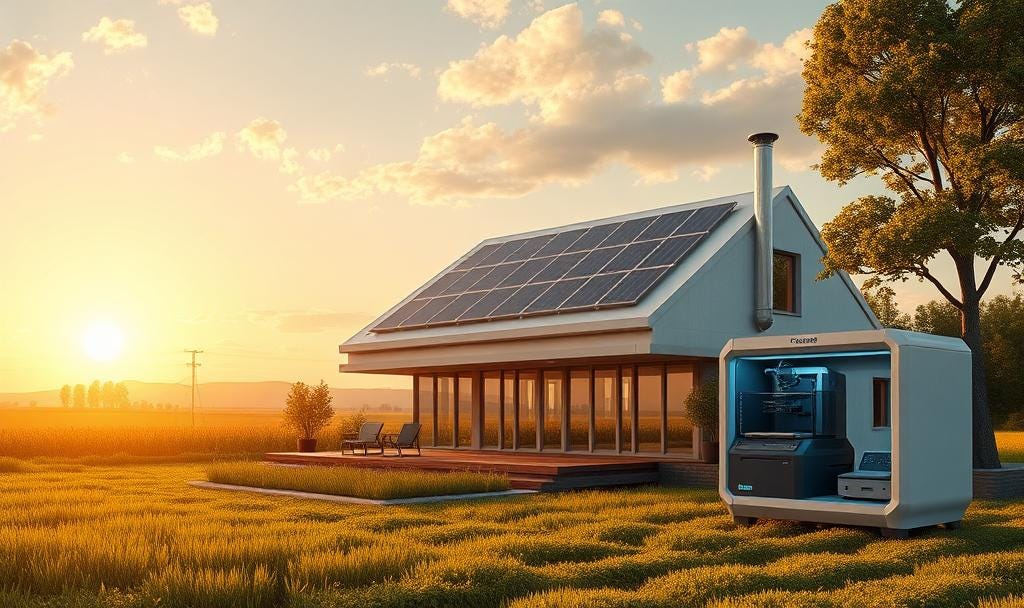
This convergence of robotics, renewables, AI, & digital fabrication is creating a futuristic homesteading renaissance. Homes become workshops and power plants, as self-watering gardens climb kitchen walls, machines knit clothes to order, and rooftop panels hum quietly under the sun. The very levers that once belonged to billion-dollar companies are now available, at human scale, in the places we live.
The result is not a retreat into isolation, but the opposite: an explosion of local and global exchange. Families produce more of their own essentials, yes, but they also create surplus, a new kind of abundance that flows into neighborhood markets and digital platforms alike. A retired engineer in Tampa designs an open-source water filter, and households in Manila print and improve it. A mother in Lagos builds a side business in solar-charged kitchen appliances, shipping them directly across the continent.
In this world, entrepreneurship is not the exception but the everyday. Every household becomes a node in a vast network of creation and trade.
The Marketplace of Experience
As homes produce more essentials, food, energy & tools then more of our money can be used for non-essentials. Instead, we begin to purchases stories, joy, connection. The data already points there: two-thirds of global consumers now prioritize “bucket-list” experiences over goods, with affluent consumers shifting spending to travel and fulfillment, per Mastercard . Globally, the “experience economy” is booming, driven by emotional connection and memories ; even Millennials favor vacations over possessions.
By 2035, this cultural shift is magnified. Neighbors exchange small lessons, beekeeping, song-making, forest walks. Creators share workshops, recipes, music, and receive compensation directly from audiences who value those experiences.
This new economy of experience, built on decentralized, personal creation, channels passion to generate profits. Meanwhile connection with others in shared experiences now becomes a main form of consumption.
The Future of Leverage
In the 20th century, business held the tools of leverage; in the 21st, that power begins to move out to the edge - to rest with individuals. Homes become autonomous production centers, powered by AI, robotics, renewables, and digital fabrication, all tools once out of reach.
The hypothesis: That money is time, and that leverage is shifting outward, is no longer speculative. It’s already observable. Autonomous farm machinery is real; solar is affordable; personal fabrication and AI tools are everywhere.
So the question becomes: What will we spend our time on once we no longer need to sell most of it to survive?
I am betting we will turn the money store of our time back into hours of joy: laughing around dinner tables, teaching in gardens, crafting on weekends, walking beneath old trees, being fully alive. Back to being human.
What a time to be alive!
Sources: